
After the Padres’ 3-15 defeat to the Dodgers, the final score only told part of a much more complicated story, one that immediately spilled beyond the field and into a storm of interpretation, disagreement, and emotional reaction. The game itself had swung heavily in favor of Los Angeles early, but by the time the last out was recorded, attention had already begun shifting toward several disputed moments that both dugouts viewed through completely different lenses.

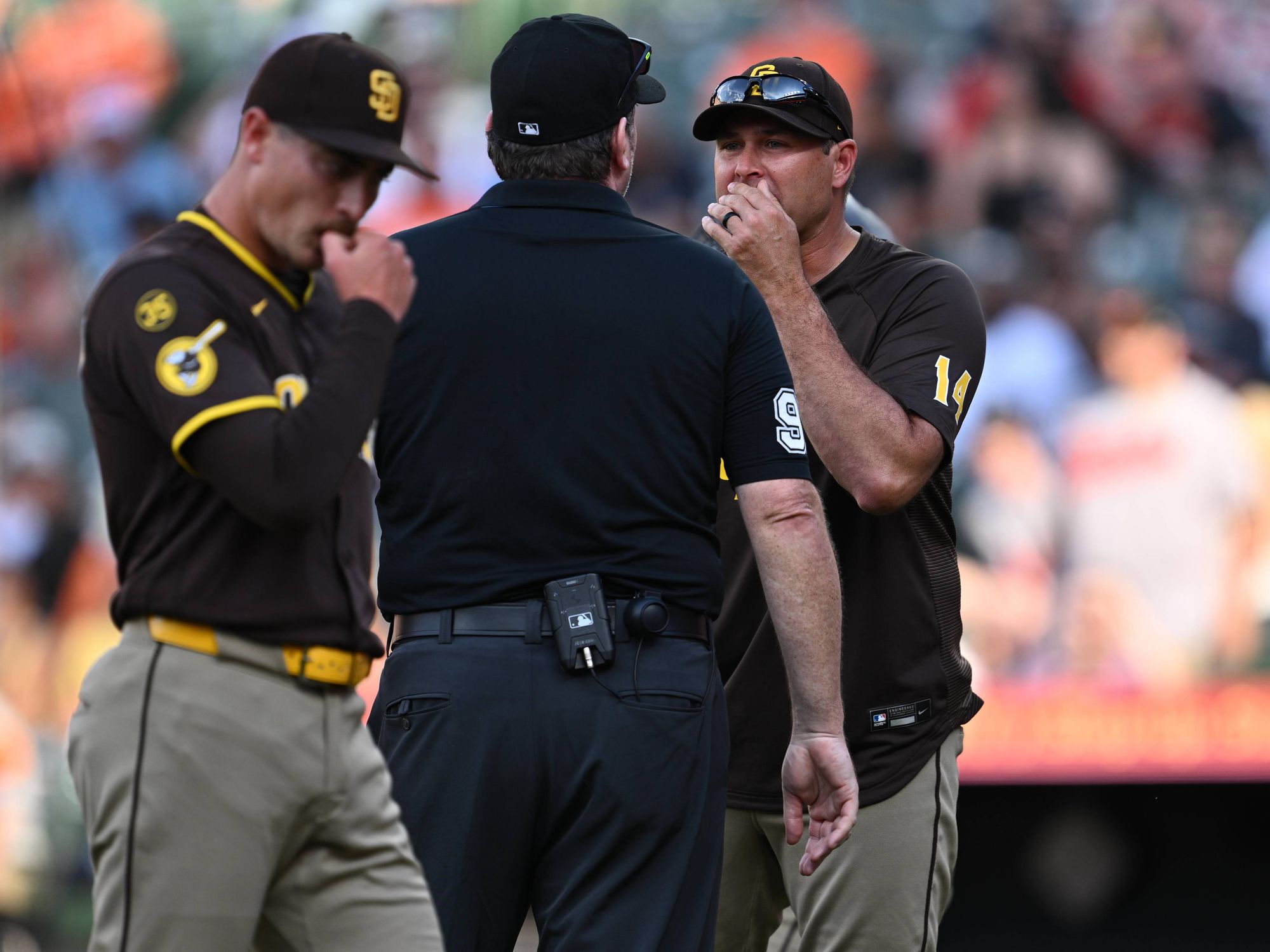
In the center of that emotional aftermath stood Padres manager Craig Stammen, whose frustration was less about the margin of defeat and more about what he believed were decisive turning points that shaped the game’s rhythm.
From the Dodgers’ perspective, however, the night represented a commanding performance built on execution, patience, and timely hitting, with manager Dave Roberts emphasizing control and consistency rather than external factors. The contrast between the two dugouts was striking: one side reflecting on missed opportunities and pivotal moments, the other focused on capitalizing on momentum and maintaining pressure across nine innings. This divergence in interpretation became the foundation for the post-game narrative that quickly overshadowed the game itself.
The controversial elements of the match were not centered on a single play, but rather a sequence of borderline calls, close plays at the bases, and strike-zone interpretations that gradually built frustration for the Padres. Each moment on its own might have been considered part of the natural variability of the game, but together they formed a pattern that Stammen and his coaching staff felt had influenced the tempo and emotional flow of the contest. In high-stakes matchups like this, perception often becomes as powerful as the action itself, and that perception quickly began shaping the post-game conversation.

Inside the Padres dugout, the atmosphere was described as tense but controlled, with players replaying key innings in their minds and discussing how small shifts might have changed the momentum earlier in the game. The 3-15 scoreline, while clearly decisive, did not fully capture the internal sense of missed alignment at critical moments. For Stammen, the focus was not on denying the Dodgers’ offensive explosion, but on understanding how the game had gradually tilted in ways that felt difficult to recover from once momentum had been lost.
On the opposite side, the Dodgers’ dugout reflected confidence and composure, shaped by a performance that combined disciplined pitching sequences with aggressive batting approaches that punished any lapses in execution. Dave Roberts’ messaging after the game emphasized preparation and adaptability, highlighting how his team responded to pressure situations without deviating from their approach. From this standpoint, the game was not about external interpretation, but about internal consistency and the ability to execute under competitive conditions.
As media crews gathered after the final out, the narrative quickly expanded beyond the scoreboard. Reporters pressed both managers on specific moments that had drawn visible reactions during the game, particularly sequences where disputed calls appeared to influence pacing and decision-making on both sides. Stammen chose his words carefully but firmly, suggesting that several turning points deserved closer examination, not as excuses, but as part of a broader conversation about consistency in high-level competition.

Roberts, meanwhile, maintained a steady tone, acknowledging the emotional intensity of the game while reinforcing his belief that over the course of nine innings, outcomes are determined by execution rather than isolated interpretations. His response reflected a long-standing managerial philosophy centered on process over reaction, emphasizing that teams must adapt to the flow of the game regardless of external perceptions. This philosophical divide between the two managers quickly became one of the central talking points in post-game analysis.
Fans, as always, amplified the discussion into a much larger debate. On social media, Padres supporters replayed key moments from the game, focusing on sequences they believed disrupted their team’s rhythm or halted potential rallies. Dodgers fans, on the other hand, highlighted the offensive dominance of their lineup and the efficiency with which their pitchers navigated high-pressure situations. The same game, viewed through two completely different emotional frameworks, produced two entirely different stories.
Analysts entering the discussion attempted to bring structure to the debate, breaking down inning-by-inning sequences and examining how momentum shifted throughout the night. Some pointed out that the Dodgers’ early scoring surge forced the Padres into a reactive position, which naturally increases scrutiny on marginal calls and close decisions. Others emphasized that over a nine-inning span, teams must absorb adversity and adjust rather than allow isolated moments to define the broader outcome.
Within this broader conversation, Stammen’s post-game tone became a focal point not because of confrontation, but because of its underlying sense of urgency. His comments reflected a manager grappling with the challenge of maintaining competitive standards in a game where small margins can feel disproportionately impactful. For him, the issue was not about assigning blame, but about ensuring clarity and consistency in how pivotal moments are experienced by both teams.
Roberts’ response, in contrast, reinforced a perspective built on trust in process and long-term performance trends. By emphasizing execution and resilience, he reframed the conversation away from interpretation and back toward the Dodgers’ ability to convert opportunities into results. This difference in framing—between interpretation and execution—became the intellectual core of the post-game discourse.
As the hours passed, the 3-15 result remained fixed in the record books, but the meaning of the game continued to evolve in public conversation. What began as a straightforward win for the Dodgers had transformed into a layered discussion about momentum, perception, and the fine line between competitive disagreement and narrative construction. In modern baseball, the story rarely ends with the final out; instead, it continues in press rooms, interviews, and digital spaces where interpretation becomes its own kind of competition.
Players from both teams eventually moved on to preparation for their next series, but the echoes of the matchup lingered in subtle ways. For the Padres, the focus turned toward regaining rhythm and converting competitive stretches into tangible results. For the Dodgers, the challenge was maintaining consistency while navigating the external narratives that often follow dominant performances. Both teams, in their own ways, understood that a single game can expand far beyond its statistical outcome.
Ultimately, the night served as a reminder that in elite sports, the scoreboard is only one layer of truth. The deeper story often lies in how the game is perceived, discussed, and remembered by those who experience it from different sides. Between Craig Stammen’s urgency for clarity and Dave Roberts’ emphasis on execution, the 3-15 Dodgers victory became more than a result—it became a conversation about how competition is interpreted in real time, under pressure, and in full public view.